
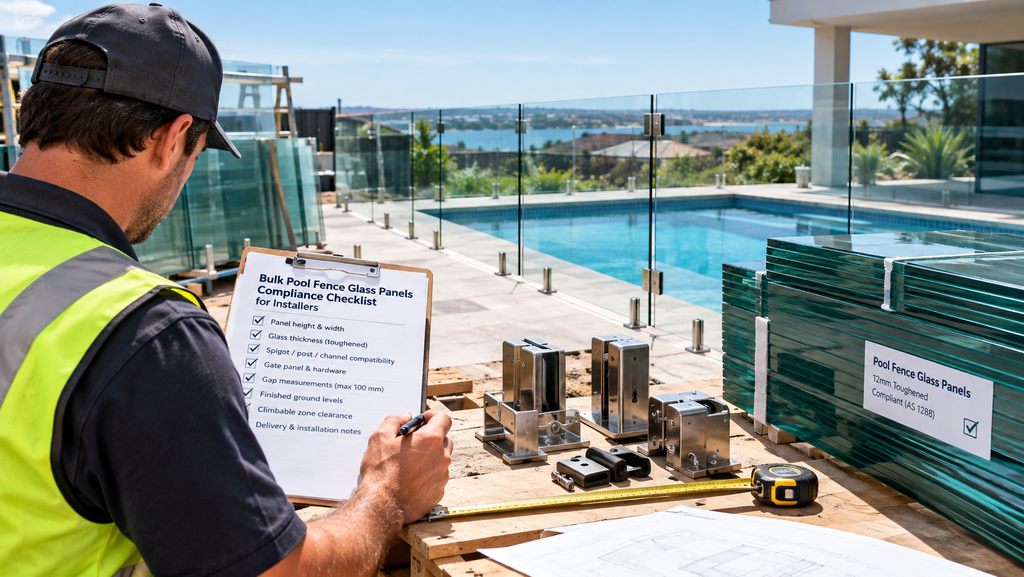
Bulk pool fence glass panels are made to order. Once a batch has been toughened, you can’t trim a panel that’s 20 mm short or move a hinge cut-out that’s in the wrong place. That’s why compliance has to be settled before you place the order, not when the pallets arrive or the certifier walks the site. This checklist covers what to verify on site, what to confirm with your supplier, and where the rules change depending on where you work.
What Should Installers Check When Buying Bulk Pool Fence Glass Panels?
When buying bulk pool fence glass panels, confirm which standard and local rules apply to each job, verify finished heights and the supporting substrate on site, check that the glass and hardware are documented for pool-barrier use, and specify gates, hinges and latches together with the panels. The sections below explain each check.
Does Pool Fencing Compliance Vary Across Australia?
Yes. Pool barriers are regulated by each state and territory, and councils, certifiers or inspectors usually apply the rules. Most jurisdictions work from AS 1926.1, but the edition, local variations and the inspection process differ. Queensland, for example, administers its own pool safety standard through the QBCC. In NSW, the standard that applies depends on when the pool was built, and the NSW Government’s pool owner obligations page notes that modifying or altering a barrier brings the current standard, AS 1926.1-2012, into play and ends earlier exemptions.
Requirements can vary by state or territory, so installers should confirm the applicable requirements with the relevant authority before installation.
Pre-Order Checklist for Bulk Pool Fence Glass Panels
1. Confirm the Standard and Jurisdiction
Record the state, council and pool construction date for every job. A bulk order often spans several sites, and one of them may sit under different rules from the rest. Work from a current copy of the standard from Standards Australia rather than summaries, including this one, when you need clause-level detail.
2. Check Barrier Height and Openings
NSW council guidance commonly cites a minimum barrier height of 1,200 mm measured on the outside, a maximum 100 mm gap under or between barrier components, and 1,800 mm where a boundary fence forms part of the barrier. Treat those as starting points and check them against the standard and your local authority. Because height is measured from finished ground level, find out whether paving, decking, turf or pool surrounds will change levels before you fix panel heights.
3. Look at Non-Climbable Zones and Nearby Structures
Glass is smooth, but sites aren’t. Retaining walls, steps, planter boxes, pool equipment and neighbouring fences can reduce effective barrier height or give a child something to climb. Published council summaries state non-climbable zone extents differently, so take figures from the standard and your authority. Plan any junction with a wall or boundary fence before ordering, as it can change panel heights.
4. Verify Glass Type and Documentation
Frameless glass pool fencing relies on toughened safety glass, but “toughened” alone isn’t a compliance statement. Ask the supplier of your bulk pool fence glass panels for the thickness, grade, edge finish and the test or certification evidence they rely on for pool-barrier use, and keep it in the job file. Don’t assume one thickness suits every system, as thickness, panel width and fixing method are specified together.
5. Build a Panel Schedule from Measurements
Work from a panel-by-panel schedule for your bulk pool fence glass panels, not a rough run length. Allow for the gap the hardware system sets between panels, keep openings within what your authority permits, and account for corners, returns and gate openings. Cumulative tolerance across a long run is where bulk jobs go wrong, so confirm the installation tolerances for your chosen system.
6. Assess Fixing Points and Substrate
Spigots, base plates and channels are only as sound as what they’re fixed to. Check slab thickness, edge distances, cracking, pavers over sand, timber decking and waterproofed areas before committing. The substrate affects which hardware is suitable, and doubtful substrates may need advice from a qualified professional. Our guide to black vs stainless steel spigots covers the trade considerations when choosing hardware finishes.
7. Specify Gates, Hinges and Latches Early
Council guidance consistently says pool gates must open away from the pool, and the standard expects gates to close and latch on their own. Hinge panels need cut-outs that match the exact hinge model, and latch type and position need to suit the gate and panel. Order these as a set with the fence panels rather than separately.
8. Allow for Slopes, Drainage and Ground Conditions
On sloping sites, decide early whether panels will be stepped or racked, and check the fall under each panel, since the maximum gap is measured against finished ground. Soft ground or water pooling around spigot bases and posts can undermine fixings over time, so address drainage before installation.
What Should Installers Confirm with a Glass Pool Fencing Supplier Before a Bulk Order?
- Panel sizes and tolerances: exact dimensions, cut-outs and edge finish for each panel type.
- Quantities: the schedule per job, plus a sensible spare allowance.
- Glass specification: thickness, grade and the documentation for pool-barrier use.
- Hardware compatibility: spigots, hinges and latches matched to the glass thickness and cut-outs.
- Site-specific requirements: share slopes, boundary junctions and substrates so the supplier can flag problems.
- Delivery and handling: site access, offloading, safe storage and the packaging used.
- Breakage and replacement: how damaged or remade panels are handled, and the lead time.
- Product documentation: the paperwork available for your certifier or inspector.
Final Pre-Order and Pre-Installation Checklist
- Standard and local requirements confirmed for each site
- Pool construction date and any barrier modifications noted
- Finished ground levels confirmed
- Barrier height, gap and boundary-fence requirements checked
- Non-climbable zones and nearby structures reviewed
- Panel schedule drawn from site measurements
- Glass specification and documentation received
- Substrate and fixing points assessed
- Hinges, latches and gate cut-outs matched to panels
- Slopes and drainage planned
- Delivery access and storage arranged
- Panels inspected for chips, damage and cut-out accuracy on arrival
- Final inspection arranged with the relevant authority or certifier
Getting Your Bulk Pool Fence Glass Panels Order Right
Bulk pool fence glass panels reward preparation. The jobs that go smoothly are the ones where the standard, site levels, substrate and hardware were settled before the glass was cut. If something on a site is unclear, ask the relevant authority or a qualified professional before you order.
If you’re pricing a run of jobs, explore our frameless glass pool fencing and pool fencing options, or talk to the team about your next project.
Frequently Asked Questions
What Should I Check Before Ordering Pool Fence Glass?
Confirm the applicable standard and local rules, finished ground levels, the substrate, the glass documentation, and the hinge and latch cut-outs. Settle these before the glass is cut, because toughened panels can’t be modified afterwards.
Is Pool Fence Glass Compliance the Same in Every State?
No. Most jurisdictions work from AS 1926.1, but the edition, local variations and the inspection process differ between states and territories. Confirm the requirements with the relevant authority before installation.
Can I Order Bulk Glass Panels Before the Site Is Finished?
It’s risky. Barrier height is measured from finished ground level, so paving, decking or landscaping that changes levels can affect panel heights. Wait for confirmed levels, or agree remake terms with your supplier first.
What Documents Should I Ask a Glass Pool Fencing Supplier For?
Ask for the glass thickness, grade and edge finish, the test or certification evidence for pool-barrier use, and hardware compatibility details. Keep these in the job file so they’re ready for your certifier or inspector.
Who Confirms That a Glass Pool Fence Is Compliant?
The relevant authority, certifier or licensed inspector, depending on the state. In NSW, certificates are only valid when issued through the NSW Swimming Pool Register. An installer shouldn’t treat a supplier’s compliance claims as a substitute for that sign-off.