
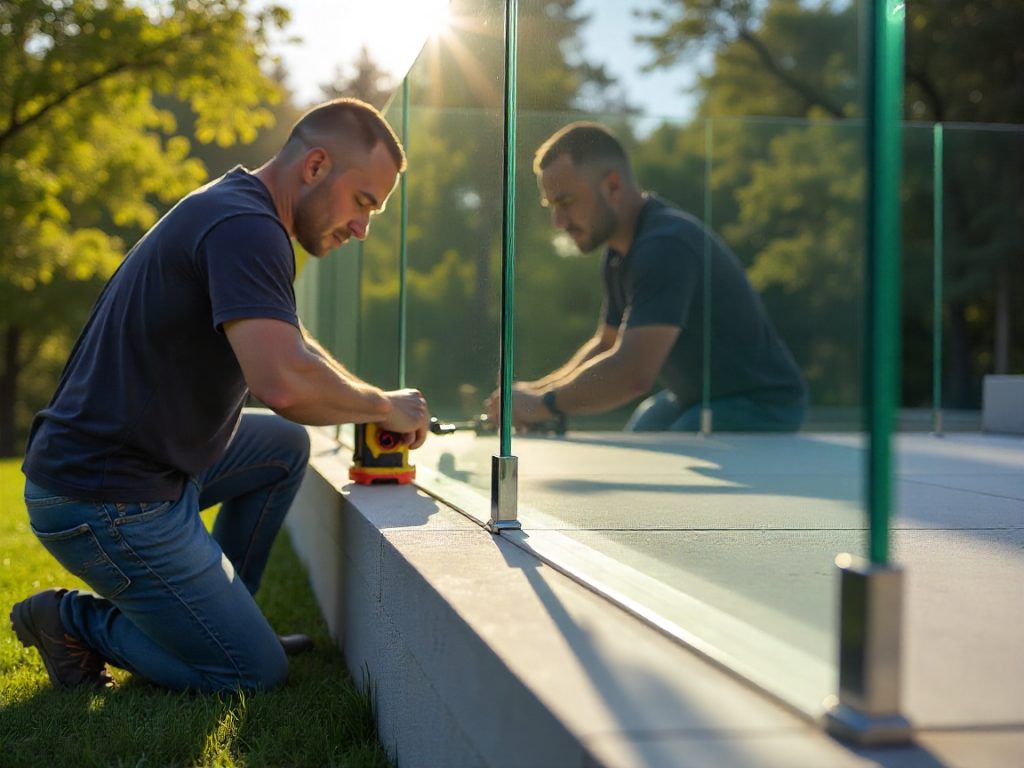
If you are planning a glass fencing installation around your pool, balcony, or outdoor area, dealing with uneven or sloped ground can be one of the biggest challenges. Many properties across Australia have gradients, dips, or sloping gardens that make standard fencing layouts difficult. The good news is that with the right sloped terrain fencing techniques and uneven ground solutions, you can still achieve a secure and elegant finish.
This guide covers professional frameless glass fence tips and proven methods to help both tradies and homeowners get the best possible results on challenging terrain.
1. Site Assessment is the Key to Success
Every professional glass fencing installation begins with a detailed site inspection. Before drilling holes or ordering materials, study your landscape to understand how much slope you are dealing with.
- Use a laser level or string line to measure height differences accurately.
- Identify soft spots or drainage issues that could cause shifting later.
- Mark out the layout before installation to visualise the flow.
If you’re unsure where to start, visit our About Us page to learn more about our team’s 50+ years of experience providing expert advice and reliable support for projects of all sizes.
2. Choose the Right Fencing System
Not all fencing systems are suitable for slopes. Selecting the right design ensures a smooth, safe, and visually appealing finish.
- Frameless glass fencing offers a minimalist look that suits modern outdoor designs. For slopes, use adjustable spigots and step the panels for clean alignment. Explore our full range of frameless glass pool fencing in Sydney to see popular options.
- Semi-frameless fencing allows for greater flexibility, making it easier to adjust for smaller gradients.
- Aluminium balustrades are excellent for steep slopes or areas needing extra support and structure.
Choosing the right sloped terrain fencing style early on will save time and help avoid costly corrections later.
3. Stepped vs Raked Installation
When performing a glass fencing installation on sloped ground, you typically have two options: the stepped method or the raked method.
Stepped Installation
Each glass panel is installed horizontally, and the entire fence steps up or down the slope in even increments.
Advantages:
- Easier to install and adjust
- Maintains consistent panel height
- Ideal for frameless and semi-frameless glass
Disadvantages:
- May leave small gaps beneath panels on steep slopes
Raked Installation
Raked fencing follows the angle of the ground continuously using specially cut panels.
Advantages:
- Smooth, seamless flow
- Works best for gentle slopes
Disadvantages:
- More expensive due to custom-cut glass
- Requires precise measurement and professional installation
If you’re looking for inspiration, browse our gallery to see examples of both methods used in real projects across NSW.
4. Adjustable Hardware and Smart Mounting
One of the best uneven ground solutions is the use of adjustable hardware. Spigots and brackets that allow micro-adjustments can make all the difference on uneven terrain.
At Glass & Fencing Warehouse, our Australian-certified products are engineered for strength and precision. Options include:
- Base-plated spigots for concrete or tiled surfaces
- Core-drilled spigots for a clean, frameless finish
- Friction-fit adjustable spigots for fine-tuning on uneven surfaces
Always check the alignment of every panel during your glass fencing installation to maintain a uniform line across the slope.
5. Compliance and Safety Standards
No matter the slope or terrain, safety remains the top priority. Australian Standards (AS1926.1-2012) define specific requirements for pool fencing height, spacing, and climb zones. Uneven ground can affect these measurements, so double-check each section carefully.
The top of your sloped terrain fencing must stay at least 1200mm above ground level across the entire length of the fence. Any gaps below should not exceed 100mm.
Need help ensuring compliance? Our expert pool fencing team in Sydney can guide you through every step, from planning to installation.
6. Protect Against Moisture and Movement
Sloped areas often experience more water flow and soil movement. To keep your glass fencing installation strong and stable:
- Seal around spigots to block moisture
- Use 316 marine-grade stainless steel hardware
- Inspect alignment regularly during installation
Proper sealing and hardware maintenance extend your fence’s lifespan and prevent corrosion.
7. Get Professional Support
Tackling a slope might seem intimidating, but expert guidance can simplify the process. At Glass & Fencing Warehouse, we’ve helped countless builders, landscapers, and homeowners across NSW transform challenging terrain into stunning, safe outdoor spaces.
Whether you need frameless glass fence tips, supply-only materials, or full installation support, our team is ready to help. You can also explore our warehouse for competitive pricing and ongoing project support.
Final Thoughts
Installing glass fencing on uneven or sloped terrain takes patience, precision, and planning. By combining the right sloped terrain fencing techniques, quality hardware, and reliable professional advice, you can achieve a beautiful and compliant finish that enhances your property’s value and safety.For trusted uneven ground solutions and expert glass fencing installation products, contact Glass & Fencing Warehouse today. We proudly serve Sydney, the Central Coast, Newcastle, and beyond with industry-leading products, unbeatable prices, and expert installation support.