
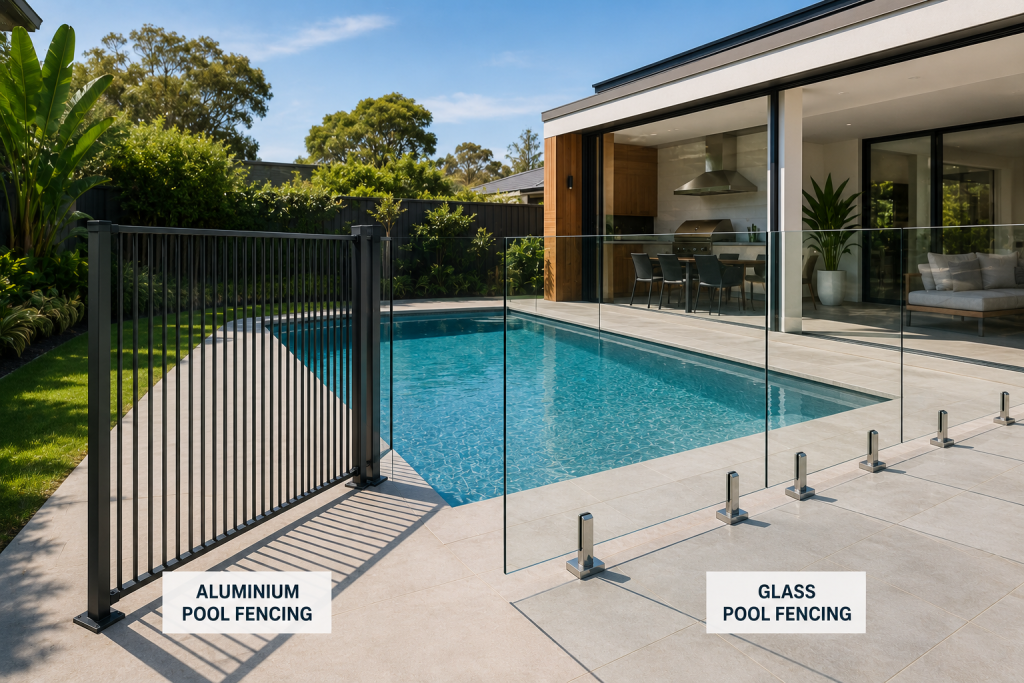
The Decision That Shapes Your Pool Area
If you are planning to install a pool fence at your Sydney property, one of the first and most consequential decisions you will face is choosing between aluminium pool fencing and glass pool fencing. Both options dominate the Sydney residential market, both can be engineered to comply with NSW pool fence regulations, and both carry distinct advantages that suit different priorities, budgets, and architectural contexts. Yet beneath these surface-level similarities lie important differences in material science, long-term cost of ownership, safety performance, and aesthetic impact that are rarely discussed in standard product guides.
This guide goes beyond the typical pros-and-cons list. We examine the engineering behind each material, unpack the regulatory framework that governs every pool fence in NSW, provide realistic cost figures based on current Sydney market rates, and offer a decision framework tailored to the specific conditions faced by Sydney homeowners, from salt-laden coastal air to the wind-load requirements that can determine whether a fence survives a summer storm.
NSW Pool Fence Regulations: The Non-Negotiable Baseline
Before comparing materials, it is essential to understand the legal framework that applies equally to every pool fence in New South Wales. The Swimming Pools Act 1992, administered by local councils, mandates that all swimming pools capable of being filled with water to a depth of 300mm or more must be enclosed by a child-resistant barrier. This barrier must comply with Australian Standard AS 1926.1, Swimming Pool Safety, Part 1: Safety Barriers for Swimming Pools, which sets out precise construction and performance requirements.
The key requirements under AS 1926.1 include: a minimum barrier height of 1200mm measured from the finished ground level; no climbable objects or surfaces within a 900mm arc measured from the top of the barrier; self-closing and self-latching gates that open outward and away from the pool area, with the latch release mechanism positioned at least 1500mm above ground level (or shielded if lower); and no vertical gaps greater than 100mm at any point in the barrier. The standard also specifies horizontal gap requirements, gate closing force, and latch engagement testing procedures.
Non-compliance carries real consequences. Under the Swimming Pools Act, local councils can issue on-the-spot fines of up to $1,100 for individual pool owners and $5,500 for corporations, and can also issue orders requiring rectification within a specified timeframe. Perhaps more critically, an non-compliant pool fence may void your home insurance policy in the event of a drowning or near-drowning incident, a risk that no Sydney homeowner should accept. Since 2013, all NSW pool owners have also been required to register their pool on the NSW Swimming Pool Register, and many councils now require a compliance certificate before a property can be sold or leased.
Both aluminium and glass pool fencing systems, when sourced from reputable suppliers and correctly installed, are designed and tested to meet these requirements. The difference lies not in whether they can comply, but in how easily and reliably compliance is achieved, and that is where material choice begins to matter.
Aluminium Pool Fencing: The Workhorse of Sydney Backyards
Aluminium pool fencing uses vertical tubular pickets or flat-bar infill panels mounted between aluminium or steel posts, typically set into concrete footings. It is the most widely installed pool fencing type in Australia, and for good reason: it offers a compelling balance of affordability, durability, and ease of installation that has made it the default choice for decades.
What You Need to Know About the Material
Not all aluminium fencing is created equal. The alloy grade matters significantly. Quality pool fencing in Australia is typically manufactured from 6060-T5 or 6063-T5 aluminium alloys, which offer an optimal balance of strength, formability, and corrosion resistance for tubular extrusions. The T5 temper designation indicates that the material has been artificially aged after extrusion, providing a minimum tensile strength of approximately 150 MPa, more than sufficient for the structural demands of a domestic pool barrier.
The powder coating applied to these extrusions is equally important. A high-quality powder coat system involves a chemical pre-treatment (typically chromate or zirconium-based), a primer layer, and a top coat, with a total dry film thickness of 60–80 microns. This coating system is what provides the UV resistance, salt-air protection, and colour stability that keeps an aluminium fence looking new for years. Inferior products with thin or improperly cured powder coat may chalk, fade, or blister within 3–5 years, particularly in Sydney’s coastal suburbs where salt deposition rates can exceed 100 mg/m²/day.
Advantages of Aluminium Pool Fencing
Cost-effective
Aluminium fencing typically costs between $80 and $150 per linear metre, installed, depending on the profile, colour, and site conditions. This makes it roughly 40–60% less expensive than frameless glass for the same perimeter, a significant consideration for large pools or properties with long boundary runs.
Low maintenance
Aluminium does not rust, corrode, or require painting. The powder-coated surface is inert and non-porous, meaning a simple hose-down every few months is usually sufficient to remove dust and debris. There are no seals to degrade, no panels to polish, and no hardware that requires regular lubrication beyond the gate hinges and latch.
Durable in harsh conditions
Properly powder-coated aluminium is resistant to UV degradation, salt air, and temperature cycling. In accelerated weathering tests (AS 2312 equivalent), quality powder-coated aluminium systems show less than 5% gloss reduction after the equivalent of 10 years of Sydney sun exposure. This makes it particularly well-suited to coastal properties from Bondi to Cronulla.
Variety of styles
Aluminium pool fencing is available in a range of profiles (tubular pickets, flat-bar infill, slatted designs), colours (from classic Black and White Surfmist to Monument and Woodland Grey), and finishes (matte, satin, textured). This versatility allows aluminium to complement everything from a Federation cottage to a contemporary courtyard home.
Straightforward installation
Aluminium fencing components are lightweight (a typical 2400mm panel weighs under 10 kg), which simplifies handling and reduces labour costs. Many competent DIYers install aluminium fencing themselves, though professional installation is recommended to ensure gate compliance and structural integrity.
Limitations of Aluminium Pool Fencing
Partial visibility
While aluminium fencing with wide picket spacing allows some visual access to the pool area, it does not offer the completely unobstructed sight lines of a frameless glass system. This is a genuine safety consideration: the ability to see the pool from the kitchen or living room without visual interruption can make a material difference in supervising young children.
Traditional aesthetic
The vertical picket profile, regardless of colour, carries a distinctly traditional visual language. In the context of a minimalist contemporary home or a high-end Hamptons-style renovation, aluminium fencing can read as a functional necessity rather than a design feature, adequate, but not aspirational.
Glass Pool Fencing: The Premium Choice
Glass pool fencing uses toughened (tempered) safety glass panels supported by stainless steel spigots, channel systems, or posts. Frameless glass pool fencing, where each panel is held by two or three spigots mortared or core-drilled into the substrate, has become one of the most sought-after options for Sydney homeowners seeking a premium, resort-quality aesthetic. Semi-frameless systems, which use aluminium posts between panels, offer a middle ground on price while retaining much of the visual transparency.
What You Need to Know About the Material
The glass used in pool fencing is not ordinary window glass. Australian Standard AS 1288—2021 (Glass in Buildings, Selection and Installation) mandates that pool fencing glass must be toughened safety glass with a minimum thickness of 12 mm for frameless applications (typically 12 mm or 12.38 mm laminated toughened). Toughening involves heating the glass to approximately 620°C and then rapidly cooling it, creating compressive stress on the surface and tensile stress in the core. This process increases the glass’s mechanical strength to approximately four to five times that of annealed glass of the same thickness.
In the rare event that toughened glass does break, it fractures into small, relatively harmless granular pieces rather than sharp shards, a critical safety characteristic for a barrier surrounding water. Laminated toughened glass adds an additional layer of safety: the polyvinyl butyral (PVB) interlayer holds the fragments in place even after fracture, maintaining the barrier’s integrity until replacement.
Wind loading is an important engineering consideration that is frequently overlooked. A 1200 mm tall glass panel acts as a solid sail, and under AS 1170.2 (Structural Design Actions, Wind Actions), a typical Sydney suburban pool fence may need to withstand wind pressures of 0.65–1.0 kPa depending on the site’s wind region and terrain category. This is why professional engineering and installation are non-negotiable for glass pool fencing, an under-specified system can flex alarmingly or fail under extreme wind loads.
Advantages of Glass Pool Fencing
Unobstructed views
Frameless glass pool fencing provides completely clear sight lines to the pool area. This is not merely an aesthetic preference, it has direct safety implications. The Royal Life Saving Society’s Keep Watch program emphasises constant visual supervision as the primary layer of protection against child drowning, and a transparent barrier supports this principle more effectively than any alternative. It also maintains the visual connection between indoor and outdoor living spaces, creating a sense of spatial continuity that many Sydney homeowners value.
Premium aesthetic and property value
Glass pool fencing elevates the overall look of a pool area from functional to aspirational. Real estate professionals in Sydney’s premium markets consistently report that frameless glass fencing is perceived as a mark of quality, and can contribute to a property’s marketability and perceived value. In a competitive market, this visual premium can translate into tangible returns.
Low maintenance (with a caveat)
Glass panels are easy to clean with standard glass cleaner and a squeegee. They do not rust, corrode, or fade. The stainless steel spigots and hardware, when manufactured from marine-grade 316 stainless steel, also offer excellent corrosion resistance. The caveat is cleaning frequency: glass shows water spots, fingerprints, and salt residue more readily than any other fencing material, and most glass fence owners find that a weekly wipe-down is necessary to maintain the pristine look that justified the premium price.
Complements modern architecture
Frameless and semi-frameless glass fencing suits contemporary, Hamptons, and coastal home designs extremely well. The material’s transparency allows the architecture and landscaping to speak for themselves, rather than introducing a competing visual element.
Limitations of Glass Pool Fencing
Higher upfront cost
Frameless glass pool fencing typically costs between $250 and $400 per linear metre installed, roughly two to three times the cost of aluminium. Semi-frameless glass sits in the $180–$280 range. This price differential reflects the material cost of the glass, the engineering requirements of the hardware, and the skilled labour needed for installation.
Professional installation required
Glass pool fencing, particularly frameless systems, requires precise installation by experienced tradespeople. Spigot placement must be accurate to within millimetres, core-drilling into concrete or paving must be executed without damaging existing surfaces, and the entire system must be engineered to withstand site-specific wind loads. Improper installation is not just an aesthetic issue, it is a safety and compliance risk.
Head-to-Head: The Comparison at a Glance
The following table summarises the key differences between aluminium and glass pool fencing across the factors that matter most to Sydney homeowners:
| Factor | Aluminium Pool Fencing | Glass Pool Fencing |
| Installed cost (per linear metre) | $80 – $150 | $250 – $400 (frameless) |
| Typical lifespan | 20+ years | 20+ years |
| Maintenance frequency | Hose down occasionally | Weekly glass cleaning |
| UV / salt air resistance | Excellent (powder-coated) | Excellent (inert glass) |
| Sight lines to pool | Partially obstructed | Completely unobstructed |
| Wind load performance | Excellent (open profile) | Requires engineering (solid panels) |
| Installation complexity | DIY-friendly | Professional install required |
| Aesthetic style | Traditional / heritage | Contemporary / resort |
| Property value impact | Neutral | Positive premium |
Note: Cost figures are indicative ranges for supply and install in the Sydney metropolitan area as of 2026, based on standard residential installations. Actual costs vary with site access, ground conditions, and product specifications.
Which Is Right for Your Sydney Home?
The right choice is not about which material is objectively better, it is about which one aligns with your specific priorities, site conditions, and budget. The following framework is designed to help you think through the decision.
Choose Aluminium Pool Fencing If
• Budget is a primary constraint.
If you are fencing a large perimeter or working within a defined budget, aluminium delivers compliant, durable pool safety at roughly half the cost of frameless glass.
• Your pool area is large with a long perimeter.
On a 30-metre perimeter, the cost difference between aluminium and frameless glass can exceed $6,000, a sum that many homeowners would prefer to allocate to the pool itself or surrounding landscaping.
• You prefer a traditional or heritage aesthetic.
Aluminium fencing in classic Black or White Surfmist complements Federation, Californian Bungalow, and traditional brick homes without introducing a visual element that feels at odds with the architecture.
• You want a straightforward installation.
If you are a competent DIYer or want to minimise installation time and cost, aluminium’s lightweight components and simple post-and-rail system make it the more accessible option.
Choose Glass Pool Fencing If
• You want a premium, modern look.
Frameless glass transforms a pool area from a backyard utility into an architectural feature. If your home features clean lines, open-plan living, or a Hamptons-inspired palette, glass fencing completes the vision.
• Clear sight lines are a priority.
If your pool is visible from living areas, glass fencing maintains an uninterrupted visual connection that supports child supervision and creates a sense of spaciousness.
• You are prepared to invest more upfront.
Glass fencing costs more, but it delivers a visual quality and property value uplift that many homeowners consider a worthwhile long-term investment.
• Your property is in a premium market.
In Sydney’s competitive real estate market, frameless glass fencing is increasingly expected rather than aspirational. It signals quality to potential buyers and can differentiate your property.
Finding the Right Supplier
Regardless of which material you choose, the quality of the product and the precision of the installation determine whether your pool fence will perform as intended, both as a safety barrier and as a lasting feature of your property. Poorly manufactured aluminium with inadequate powder coating will degrade prematurely; improperly installed glass will flex, rattle, or fail to meet the gate-closing requirements of AS 1926.1.
Glass and Fencing Warehouse, based in Sydney, stocks a comprehensive range of both aluminium and glass pool fencing products and has a trade team experienced in helping homeowners, pool builders, and landscapers compare options, calculate materials, and find the right system for their project and budget. Whether you are at the planning stage or ready to order, their Sydney warehouse is worth a visit or a call to discuss your specific requirements.