
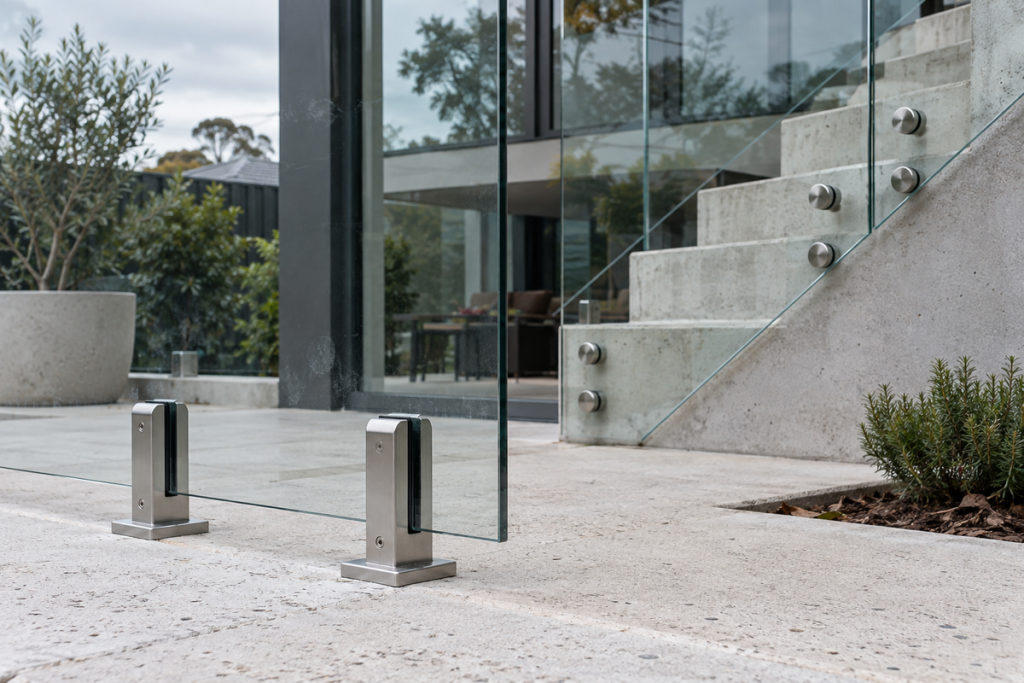
Choosing friction spigots vs standoff changes how a glass barrier transfers loads into its supporting structure. The systems can both create a frameless appearance, but they do not use the same glass fabrication, substrate preparation or installation method.
Friction spigots clamp the glass without requiring holes through the panel. Standoff pins pass through factory-drilled holes and support the panel away from a wall, fascia, post or stringer. Understanding this difference between Friction Spigots vs Standoff helps prevent incorrect orders, damaged panels and fixing systems that do not suit the site.
How Friction Spigots Hold Glass
A friction spigot supports glass by clamping the panel between protected jaws. Gaskets separate the metal from the glass and the spigot body transfers loads into a concrete footing, slab, deck beam or other suitable structure. Common versions are core-drilled into concrete or surface-mounted on a base plate.
Because the glass does not require a fixing hole, fabrication is comparatively straightforward. A damaged rectangular panel can usually be replaced without reproducing exact hole centres. This is one reason friction spigots are widely used for pool fencing and many outdoor glass barriers.
Correct installation is still essential. Under-tightening may allow the panel to move, while over-tightening can place excessive pressure on the glass. Spigot spacing, gasket position, panel dimensions and substrate capacity must work as one system.
How Standoff Pin Fixings Hold Glass
A standoff pin supports glass through a factory-drilled hole. A pin, bolt and protective bushing pass through the panel, holding the glass away from the face of a wall, fascia, steel stringer or structural post. The result is a clean floating appearance often used on stairs, balcony returns, feature screens and architectural balustrades.
The fixing hole changes the way stress is distributed through the panel. Hole diameter, edge distance, bushing type, washer size and pin position must be included in the glass specification before toughening. Toughened glass cannot be drilled or altered on site. If a hole is incorrectly located, the panel normally has to be remade.
Friction Spigots vs Standoff Comparison
| Factor | Friction spigots | Standoff pin fixings |
| Glass fabrication | No fixing holes through the panel | Factory-drilled holes required |
| Load path | Glass to clamp to spigot and substrate | Glass hole to pin and backing structure |
| Typical use | Pool fences and deck barriers | Stairs, fascias and feature barriers |
| Alignment | Accurate spigot spacing and clamp pressure | Exact hole centres and pins set in plane |
| Replacement | Usually simpler rectangular panel replacement | Replacement must reproduce hole geometry |
| Visual effect | Minimal floor-mounted hardware | Floating face-mounted appearance |
Load Transfer and Structural Support
Friction spigots generally perform best with a continuous, sound substrate. Core-drilled spigots are commonly installed into concrete or an engineered footing. Surface-mounted versions require suitable anchors and a supporting structure capable of resisting the imposed loads.
Standoff pins act as concentrated point fixings. The backing structure must resist loads without crushing tiles, cracking finishes or pulling away from the building. On steel stringers, pin locations may need to be coordinated during fabrication. On walls and fascias, the visible finish should not be mistaken for the structural support behind it.
Glass Drilling Thickness and Replacement
When comparing friction spigots vs standoff, the absence or presence of glass holes is one of the biggest practical differences. Friction-held panels are ordered to size with polished edges. Standoff panels require an approved shop drawing showing every hole before the glass is toughened.
Glass thickness should not be selected from appearance alone. Panel height, span, wind exposure, barrier use and the fixing system can all affect the specification. Pinned systems may require thicker or differently engineered glass because loads are introduced around drilled holes.
Replacement is generally faster with friction-held rectangular panels. A pinned panel must reproduce the original hole diameter and location accurately, which can increase manufacturing time and replacement cost.
Substrate Waterproofing and Coastal Exposure
Core drilling can encounter reinforcement, services or waterproofing membranes. Surface mounting avoids some drilling depth but increases reliance on anchors, tile adhesion and the supporting structure. Standoff pins also need suitable packing so the fixings sit in one plane without loading decorative finishes.
Water entry and corrosion can affect both systems. Penetrations should be detailed and sealed for the location, and stainless-steel grades should suit the exposure. Coastal and pool environments may require higher corrosion resistance than protected inland locations.
Which Glass Fixing System Suits the Project
Friction spigots are commonly suitable for straight pool-fence runs, outdoor barriers and deck balustrades where glass without fixing holes is preferred. Standoff pins can suit stairs, wall-mounted barriers and feature glass where the backing structure and hole geometry are known before manufacture.
Do not combine the systems without resolving panel heights, load transfer, waterproofing and the junction between fixing types. The most visually minimal detail is not automatically the most appropriate structural detail.
Choose the Correct Glass Barrier Hardware
Glass & Fencing Warehouse supplies glass pool fencing and hardware, including spigots, gates and custom glass for Sydney and NSW projects.
Trade customers can provide drawings, panel dimensions and substrate details so the fixing system can be matched to the project before glass is ordered.
For building and barrier requirements, refer to the National Construction Code and obtain project-specific advice where required. Call (02) 9627 9500 or request a quote through glassandfencingwarehouse.com.au.
Friction Spigots vs Standoff FAQs
1. Do friction spigots require holes in the glass
No. The glass is held by clamping pressure with protective gaskets between the panel and the spigot.
2. Can standoff holes be drilled after toughening
No. Hole positions and sizes must be finalised before the panel is toughened. Attempting to drill toughened glass will cause it to break.
3. Which fixing is more common for pool fencing
Friction spigots are more commonly used for typical frameless pool-fence runs because they hold the glass without factory-drilled fixing holes.
4. Does the substrate affect the fixing choice
Yes. The structure behind the visible surface must support the barrier loads, anchors and fixing geometry. Tiles, render or cladding alone are not structural supports.